For overseas dentists planning to build a career in the UK, understanding the different training and validation pathways is essential. Two terms that often cause confusion are VTE vs PLVE. Although they are closely related, they serve different purposes and have developed differently over time.
Many dentists assume they are interchangeable because both have been linked to joining NHS dentistry. In reality, each pathway was introduced to address a different requirement, and recent changes to NHS processes have made the distinction even more important.
Before applying for VTE or PLVE, overseas-qualified dentists must first obtain General Dental Council (GDC) registration.
What is Vocational Training by Equivalence?
Vocational Training by Equivalence (VTE) is the process of demonstrating that a dentist’s education, clinical experience and professional competencies are equivalent to those gained through UK Dental Foundation Training.
In the UK, dental graduates normally complete one year of Foundation Training before they can work independently in NHS primary care. Overseas-qualified dentists do not automatically receive this recognition, even if they have several years of clinical experience.
VTE provides a way to assess whether a dentist has already developed the knowledge, skills and professional standards expected of a UK Foundation Dentist.
The assessment focuses on areas such as:
- Clinical competence
- Patient communication
- Professional judgement
- Record keeping
- Ethical practice
- Understanding of NHS dentistry
What is Performers List Validation by Experience (PLVE)?
Performers List Validation by Experience (PLVE) is an NHS England pathway for overseas-qualified dentists who want to join the NHS Performers List without completing UK Dental Foundation Training.
The route is intended for dentists who already hold GDC registration but need to demonstrate that they have the clinical knowledge, skills and professional standards required to work in NHS primary care.
Unlike VTE, which focuses on whether a dentist’s previous training is equivalent to UK Foundation Training, the PLVE pathway assesses whether a dentist is ready to provide NHS dental care. This is typically achieved through a period of supervised practice, workplace-based assessments, regular reviews and evidence gathered during clinical practice.
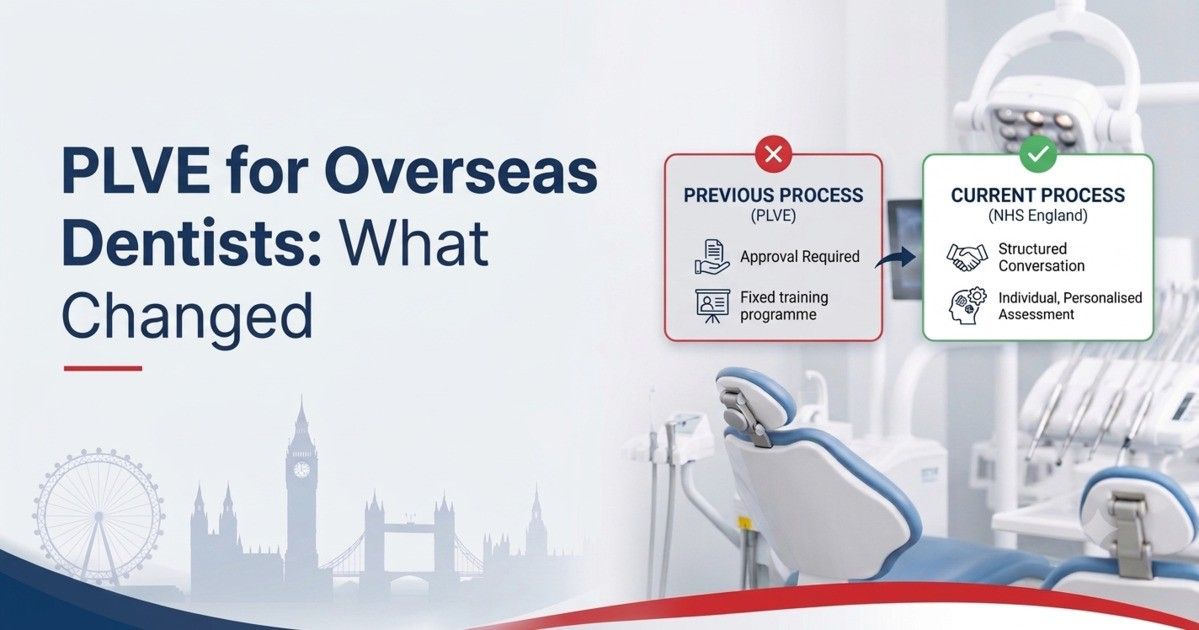
Traditionally, the PLVE route involved working in an approved NHS practice under the supervision of a Validation Supervisor. During this period, dentists completed workplace-based assessments and regular reviews before being recommended for entry to the NHS Performers List.
The traditional PLVE route generally included:
- Supervised NHS practice
- Workplace-based assessments
- Regular meetings with a Validation Supervisor
- A portfolio of clinical evidence
- Assessment for entry to the NHS Performers List
Since April 2023, NHS England has updated its assessment process. In many cases, applicants are now assessed through a structured conversation with an NHS England Dental Advisor and a Postgraduate Dental Dean representative, rather than a separate PLVE application process.
Who Needs VTE and Who Needs PLVE?
Although VTE and PLVE are often mentioned together, they are intended for different groups of dentists.
Who Needs VTE?
VTE may be suitable if you:
- Qualified in the UK, EU or EEA.
- Have not completed UK Dental Foundation Training.
- Need to demonstrate that your previous training and experience are equivalent to Foundation Training.
- Intend to work in NHS primary care where Foundation Training equivalence is required.
Who Needs PLVE?
PLVE is generally intended for internationally qualified dentists who:
- Qualified outside the UK, EU or EEA.
- Hold full GDC registration.
- Wish to join the NHS Performers List.
- Need to complete a supervised route into NHS primary care.
Thinking about moving to the UK? If you require a Skilled Worker visa, Saint Visage provides full visa sponsorship support for eligible candidates, along with guidance on GDC registration, relocation and onboarding, helping simplify the transition to practising in the UK.
How Long Does It Take to Practise Independently?
One of the most common questions overseas dentists ask is how long it takes to work independently in the UK.
The answer depends on the route you take:
- VTE: Completes within one year, depending on your individual circumstances and programme requirements.
- PLVE: Typically takes 6–18 months, depending on your progress, supervision requirements and how quickly you meet the NHS Performers List requirements.
Looking for Personalised Support?
Choosing between VTE and PLVE is only part of planning your career in UK dentistry. Understanding which route applies to your qualifications is important, but having the right support throughout the process can make the transition much smoother.
At Saint Visage, we provide tailored support for internationally qualified dentists through dedicated VTE & PLVE mentorship, structured onboarding and clear career pathways into UK practice. From helping you understand the most suitable route to supporting your professional development after you begin practising, our focus is on building long-term careers rather than simply filling vacancies.
Saint Visage has supported over 1,000 overseas dentists through GDC registration and into UK practice. Whether you’re just starting your research or ready to begin your application, contact Saint Visage to learn how we can support you at every stage of your UK dental career.
Final Thoughts
Understanding the difference between VTE vs PLVE is an important step for any dentist planning to work in the UK.
While both routes are linked to NHS dentistry, they serve different purposes. VTE is primarily associated with UK, EU and EEA-qualified dentists who need to establish Foundation Training equivalence, whereas PLVE is the route commonly followed by internationally qualified dentists seeking entry to the NHS Performers List.
Knowing which route applies to your qualifications can help you plan your career with greater confidence and prepare for the requirements of NHS practice.
Frequently Asked Questions
Can I work in the NHS with GDC registration alone?
No. GDC registration allows you to practise dentistry in the UK, but dentists who wish to provide NHS treatment in England must also meet the requirements for entry to the NHS Performers List.
Can I work in private practice without VTE or PLVE?
Yes. You can work in a purely private dental practice in the UK without VTE or PLVE, provided you hold full registration with the General Dental Council and have valid professional indemnity cover. However, you will be strictly restricted from providing any NHS treatments or joining the NHS Performers List.
Can I apply for PLVE without GDC registration?
No. You must hold full GDC registration before you can follow the PLVE route.
Does VTE lead to the NHS Performers List?
VTE establishes Foundation Training equivalence. If you plan to work in NHS primary care, you must also meet the requirements for joining the NHS Performers List.
Will I Be Paid During VTE/PLVE?
Yes. Dentists undertaking supervised practice are paid. During the supervised practice period (such as Dental Foundation Training or an equivalent pathway), annual earnings are typically in line with NHS pay scales, £43,893 per year.