Many overseas dentists in the UK want to continue their careers after moving abroad. To practise legally, they must register with the General Dental Council (GDC).
The two main routes are the ORE exam and the LDS exam in the UK. Both exams test clinical knowledge and practical skills. However, they differ in cost, structure and availability.
This guide compares ORE vs LDS to help international dentists choose the right pathway.
What is the ORE Exam?
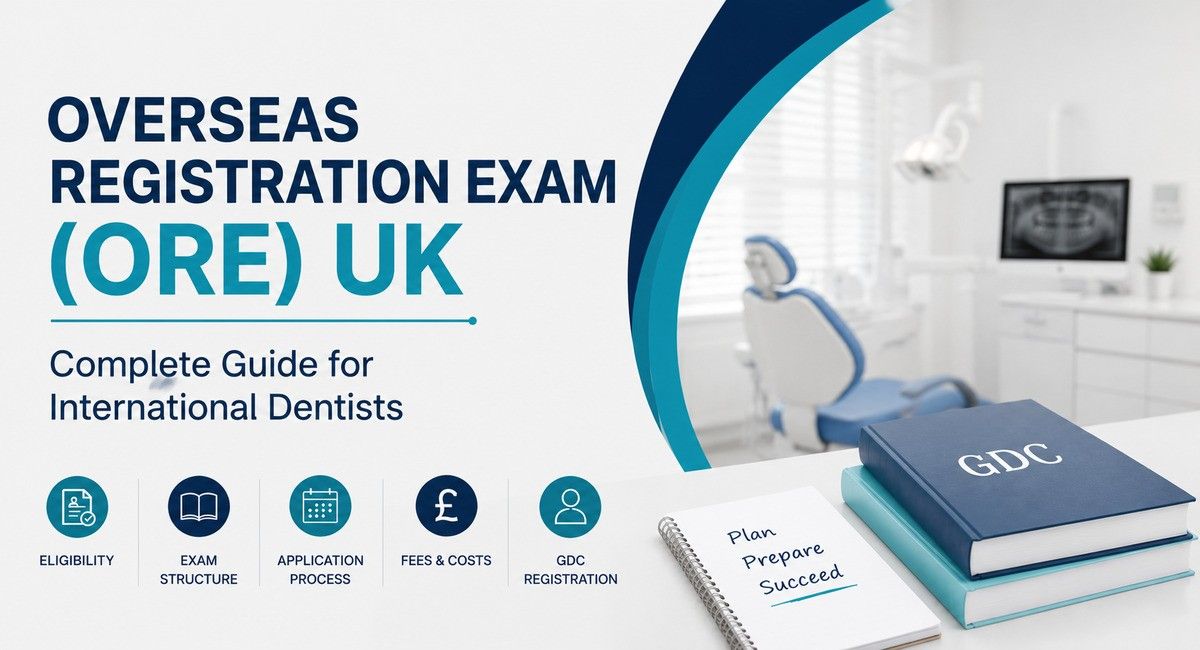
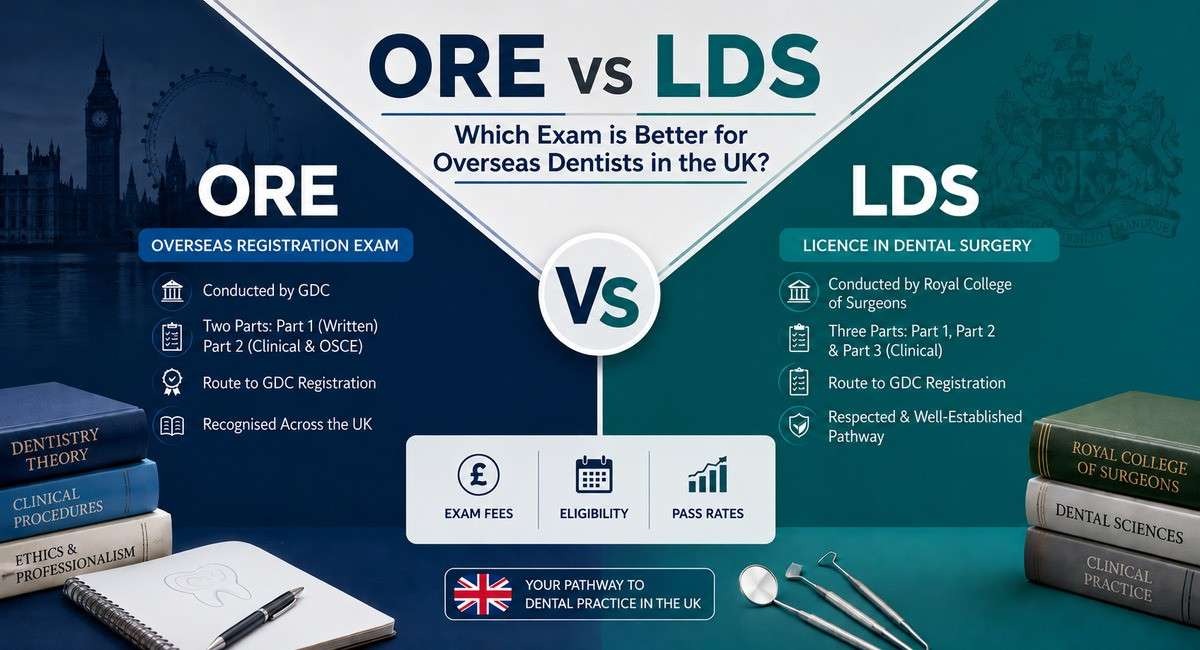
ORE stands for Overseas Registration Examination. It is a licensing exam for dentists who qualified outside the EU/EEA. The General Dental Council (GDC) conducts the ORE exam. The GDC is the official body that regulates dental professionals in the UK.
The ORE exam for overseas dentists checks whether international candidates meet UK clinical standards. It assesses theoretical knowledge, patient safety, communication and practical skills.
The ORE exam structure has two parts.
Part 1: Written (Computer-Based)
Part 1 consists of two papers, three hours each, using extended matching questions and single best answer. Both papers are sat on the same day and must both be passed to progress to Part 2.
- Paper A covers clinically applied dental science and human disease.
- Paper B covers clinical dentistry, law, ethics and health and safety.
Part 2: Clinical and Practical Assessment (In-Person)
Part 2 tests hands-on clinical competence through four mandatory components:
- An OSCE (Objective Structured Clinical Examination)
- A Dental Manikin operative test
- A Diagnosis and Treatment Planning exercise
- A Medical Emergencies assessment
Candidates have a maximum of four attempts at Part 2. Additionally, please note the strict time limit: both parts of the ORE must be successfully passed within five years of your very first Part 1 exam sitting.
ORE Eligibility Criteria
To apply for the Overseas Registration Examination (ORE), candidates must hold a primary dental qualification. Applicants must also verify a minimum of 1,600 hours of clinical experience where they have personally treated patients.
Additionally, a Certificate or Letter of Good Standing from their local dental regulatory authority must be provided, issued within three months of the application date.
Finally, candidates must meet the GDC’s English language requirements, primarily through the Academic IELTS exam, as the OET is not accepted for this route.
ORE Exam Fees
The ORE exam requires a £115 application fee, followed by £485 for Part 1 and up to £6,967 for Part 2, plus extra costs for travel and preparation. Candidates who fail only the Medical Emergencies component of Part 2 can complete a standalone retake for £686.
What is the LDS Exam?
The LDS exam stands for Licence in Dental Surgery. It is conducted by the Royal College of Surgeons of England. The exam is another recognised route for overseas dentist registration in the UK.
It allows international dentists to apply for GDC registration after successful completion.
The LDS consists of three sequential parts. Candidates must pass each part before moving to the next.
Part 1: Written (Remote)
The LDS Part 1 is a remote, online-based examination consisting of two 150-minute papers taken on the same day, featuring a combination of Single Best Answer (SBA) questions and Extended Matching Questions (EMQs).
- Paper A: Covers dental science and human disease.
- Paper B: Covers clinical dentistry, law, ethics and health and safety.
Both papers must be passed in the same sitting.
Part 2: Clinical Assessment (In-Person)
This face-to-face exam is held over two days and tests your communication and clinical judgement:
- OSCE (Objective Structured Clinical Examination): 12 practical stations testing clinical and communication skills, with each station lasting seven minutes.
- SCR (Structured Clinical Reasoning): Six 20-minute discussion cases with examiners focusing on diagnosis and treatment planning.
Part 3: Operative Assessment (In-Person)
This is a one-day, 180-minute hands-on test using a dental manikin to evaluate your practical surgical skills. The primary tasks include:
- Cavity Preparations: Cutting specific shapes and complex box designs into target teeth.
- Crown Preparations: Shaping teeth for Full Gold Crowns (FGC) or Porcelain Fused to Metal (PFM) restorations.
- Restorations: Placing composite fillings and building up missing tooth structures.
LDS Eligibility Criteria
To take the LDS, candidates must hold a GDC-recognised dental qualification and complete at least 1,600 hours of clinical experience. Candidates must also demonstrate a high level of English language proficiency, such as an IELTS score of at least 7.0 overall, with no individual component score below 6.5.
In addition, candidates are required to provide a letter of good standing from their dental regulatory authority and a completed clinical reference form. A completed LDS Character Reference Form from an undergraduate teacher, professor, or supervisor is also required.
LDS Exam Fees
The exam fee for Part 1 is £1,025, while Part 2 costs around £1,793. The fee for Part 3 is approximately £1,736.
ORE vs LDS: Key Differences
Both exams lead to registration with the GDC. However, there are important differences between the ORE vs LDS exams
- The ORE exam UK is managed directly by the GDC, while the LDS is conducted by the Royal College of Surgeons.
- Both pathways include written and practical assessments. However, the ORE is a two-part exam, whereas the LDS is split into three distinct parts.
- The ORE is known for limited seat availability and strong competition during booking periods.
- The LDS may offer different scheduling opportunities depending on exam dates and availability.
In terms of recognition, both pathways are accepted equally for GDC registration of overseas dentists.
The ORE Booking Challenge
Securing a seat for the ORE has historically been a major challenge for overseas dentists. Because thousands of candidates apply simultaneously, exam places sell out within a short-time after being released. This makes early preparation and staying updated on GDC booking announcements essential for every candidate.
Which Exam is Better for Overseas Dentists?
There is no single answer in the ORE vs LDS debate. Both exams lead to GDC registration and allow overseas dentists to practise legally in the UK.
The right option depends on the candidate’s goals, budget and preparation style. Some dentists prefer the ORE exam UK because it is conducted directly by the GDC. Others choose the LDS exam UK because of the reputation of the Royal College of Surgeons.
Candidates should compare the following before choosing a pathway:
- Total exam cost
- Seat availability
- Preparation difficulty
- Travel requirements
- Waiting periods
Preparation Tips for ORE and LDS Exams
Preparing properly is essential for success in either exam. Many overseas dentists spend several months preparing for practical and theoretical assessments.
Helpful preparation strategies include:
- Studying UK dental guidelines
- Practising OSCE scenarios
- Improving patient communication skills
- Joining study groups
- Attending revision courses
- Solving mock exam papers
- Practising Structured Clinical Reasoning (SCR) cases
Support Available for Overseas Dentists Preparing for ORE or LDS
Many overseas dentists require additional guidance while planning their UK registration journey. Understanding the exam pathway and registration process can help candidates avoid delays and prepare more effectively.
At Saint Visage, we support for overseas dentists through:
- Understanding the ORE and LDS pathways
- Guidance on choosing between ORE and LDS
- Information about eligibility requirements
- Support with exam application processes
- Advice on documentation and registration steps
- Understanding exam structure and stages
Final Verdict: ORE or LDS?
Choosing between ORE vs LDS depends on your personal goals, financial situation and preparation style. Both the ORE exam and LDS exam are recognised pathways for overseas dentists who want to practise in the United Kingdom. While the ORE is conducted directly by the GDC, the LDS is managed by the Royal College of Surgeons.
Before selecting a pathway, overseas dentists should carefully compare exam fees, seat availability, preparation requirements and long-term career plans. Strong preparation, clinical confidence and understanding of UK dental standards are essential for success in both exams.
Frequently Asked Questions
Which exam is cheaper, ORE or LDS?
Both exams involve significant expenses. Costs usually include exam fees, coaching, study materials, travel and accommodation. The total expense may vary depending on retakes and preparation methods.
Can overseas dentists work in the UK without ORE or LDS?
Most overseas-qualified dentists must pass either the ORE exam UK or LDS exam UK to gain GDC registration. Without registration, dentists cannot practise independently in the UK.
Is the LDS exam accepted by the GDC?
Yes, the LDS exam UK is fully recognised by the GDC. Candidates who pass the exam can apply for registration and legally practise dentistry in the UK.
How long does it take to complete ORE or LDS?
The timeline depends on exam availability, preparation level and booking delays. Some candidates complete the process within one year, while others may take longer because of waiting periods and retakes.
How Many Attempts Are Allowed for ORE and LDS?
For the ORE exam UK, candidates are allowed up to 4 attempts for both Part 1 and Part 2. All parts must be completed within 5 years from the first Part 1 attempt.
For the LDS exam UK, candidates can attempt Part 1 up to 4 times. However, Part 2 and Part 3 only allow 3 attempts each. All practical parts must be passed within 5 years after passing Part 1.